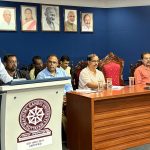
Mr Muraleedharan Nair, Founder Director of the Asian Institute for China and IOR Studies, observed that the optics surrounding the recent visit by Prime Minister Modi to Tianjin were media hype, wrongly suggesting a “reset” in bilateral relations, or the emergence of an “India-China axis” and “Russia-India- China (RIC) troika, when the true purpose was to pragmatically repair the relational equilibrium badly damaged after the Galwan incident. He mentioned it while delivering a talk on “The Potential for a Longstanding Stable India-China Relationship ” organised by the KPS Menon Chair for Diplomatic Studies, School of International Relations and Politics, Mahatma Gandhi University. He highlighted India’s paradox: the country requires Chinese cooperation to achieve ‘Atmanirbharata,’ which needs capital, machinery, electronic components, and critical raw materials such as rare earth elements, and active pharmaceutical ingredients (APIs).
However, India has clearly mandated that all Chinese investment, particularly in the financial sector, must respect India’s economic security. Geopolitically, the relationship is seen as shifting from a phase of confrontation towards cautious co-existence, but stability remains contingent on deftly managing major complexities, including the LAC (border), the issue of the Dalai Lama’s incarnation, India’s membership in the QUAD, and its aspirations for an expanded UNSC seat. He concluded by urging the faculty and other scholars to deepen the understanding of China by studying its culture, history, society and philosophy directly, arguing that reliance on Western scholarship provides a perspective that may not accurately reflect India’s strategic viewpoint.
Dr Lirar Pulikkalakath, Assistant Professor at SIRP, coordinated the event. It was followed by a dynamic exchange of ideas with students on the India-China relationship.