Kottayam, August 6, 2026
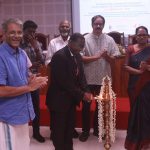
The School of International Relations and Politics (SIRP), Mahatma Gandhi University, organised an international academic session on “Human Rights and Social Policy” on August 6, 2026, in collaboration with the United States-India Educational Foundation (USEFI). Held under the Freedom 250 initiative, the programme brought together students, researchers and faculty members for an engaging discussion on contemporary human rights discourse from global and comparative perspectives.
The keynote address was delivered by Prof. Joseph M. Wronka, a four-time Fulbright Scholar, United Nations representative in New York, Professor at the International Association of Schools of Social Work (IASSW), and Professor Emeritus at Springfield College, Massachusetts, USA. He is the author of the acclaimed book Human Rights and Social Justice: Social Action and Service for the Helping and Health Professions.
Drawing on his extensive academic and international experience, Prof. Wronka explored the relationship between human rights, social justice and public policy through a comparative analysis of India and the United States. He emphasised the importance of inclusive policymaking, advocating a combination of global vision and local action to advance human rights and social justice.
Highlighting the concept of global citizenship, he observed that effective social policies must be rooted in equality, compassion and inclusivity. Quoting the principle, “Treat others as you would like to be treated; the rest is commentary,” he underscored the need for non-discriminatory approaches in governance and policy formulation.
Prof. Wronka also examined the historical evolution and continuing relevance of the Universal Declaration of Human Rights (UDHR), discussing its articles, guiding principles, conventions and declarations. He reflected on the contributions of both India and the United States to the global human rights movement and acknowledged the enduring influence of Mahatma Gandhi and Martin Luther King Jr. in shaping contemporary ideas of justice, equality and peace.
The session further addressed a range of pressing global concerns, including poverty, the impact of transnational corporations, colonial and capitalist structures, press freedom, armed conflicts, war crimes and the role of the United Nations in promoting and protecting human rights. He stressed the importance of ensuring that indigenous peoples and other marginalised communities remain central to policy discussions and decision-making processes.
The programme concluded with a call for greater international cooperation, tolerance and friendship among nations, reaffirming the universal principle of “Human rights for everybody, everywhere.”
The session was chaired and coordinated by Prof. C. Vinodan, Director of the School of International Relations and Politics. It forms part of SIRP’s continuing series of academic engagements aimed at fostering critical dialogue, interdisciplinary learning and informed debates on contemporary issues in human rights, social justice and public policy.