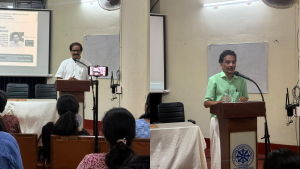
 Indian history has witnessed coalition politics triggering transformative legislation and, in turn, transformative legislation reshaping political coalitions, creating a circular relationship between the two, said former IRS officer R. Mohan.
He was delivering an expert talk at the School of Social Sciences, Mahatma Gandhi University, on Thursday.
The Travancore-Cochin government formed under the leadership of Pattom A. Thanu Pillai in 1954 is a notable example, he said. Despite being the largest political party in the country, the Congress could not form the government and instead supported the minority Praja Socialist Party in forming the ministry. The Pattom government introduced ideas such as an employment guarantee scheme and free education, which were implemented at the national level decades later, he said.
Mohan noted that transformative legislation could also have a significant impact on political alignments. The implementation of OBC reservation following the recommendations of the Mandal Commission, for instance, contributed to the Congress losing its political dominance in Uttar Pradesh, he said.
Discussing Kerala’s experience, Mohan pointed out that no political party has secured a single-party majority in the State, with the Communist Party of India (CPI) government of 1957 being an exception with the support of five Independents. The government introduced the District Councils Bill, Education Bill and Agrarian Relations Bill, all of which he described as transformative legislative initiatives.
However, these measures also generated opposition among various social groups and affected existing social coalitions. The subsequent realignment of social coalitions brought an end to what he described as a second wave of transformative legislation in Kerala.
Transformative legislation has also faced setbacks through judicial intervention, particularly in debates surrounding the right to property, Mohan said.
He recalled the contribution of former President K. R. Narayanan to the preservation of India’s federal structure. The talk examined the relationship between India’s federal system, coalition politics and transformative legislative initiatives, with particular attention to Kerala’s political experience.
Concluding the session, Mohan said transformative legislation could not be understood merely as a legislative process. Its development and impact are closely linked to social coalitions, political competition, federal relations, judicial interventions and institutional arrangements. The Indian experience, particularly that of Kerala, demonstrates how these factors interact to shape public policy and contribute to broader processes of social and political transformation.
“For federalism to succeed, it should begin at the level of local bodies,” he concluded.
The event was organised by K. R. Narayanan Chair for Human Rights and Social Justice on September 10, 2026. Prof. Rajesh Komath chaired the session.